
Most people lie in bed until they fall asleep. Not me. I inherited insomnia from my father. Whenever I have something on my mind, I go to the living room around 1 am, snuggle up in the recliner with a fleece blanket and think about what is bothering me for 2-3 hours. Usually, it involves work: an unfinished contract, licenses that are due, insurance issues, or other miscellaneous concerns.
I really should request overtime pay!
Other times, I worry about what is going on in this chaotic world and start asking myself if I am prepared for retirement or affording and maintaining health benefits. One of my biggest concerns is staying in my home if my condition worsens.
Over the last year, I have tried to escape these sleepless nights. I have changed my diet and beverage intake, thinking it may be something I ate or drank. I have increased my exercising during the day and have even wondered if it was a side effect of medication. Whatever the cause, I have simply accepted that insomnia will always be a part of my life and have learned to cope with it.
I have had more adventures in the early morning hours than most people have in a lifetime. I have wandered into the woods and rivers of the Upper Michigan Peninsula’s Big-Two-Hearted River with Ernest Hemingway and Nick Adams, and I have fished for salmon on The Vermont River with W.D. Wetherell.
Like Ships that Pass in the Night, I visited residents of a late 1800s Switzerland tuberculosis sanitarium with Beatrice Harraden. I felt the residents emotions as they dealt with love, loss, and bitterness while facing their own mortality. I joined Steven Higgs on his Culinary Capers as he told of a culinary tour of the British Isles that led two attendees, retired Chief Superintendent Albert Smith and his ex-police dog, Rex, on a trail of murder, theft, and drugs.
I followed the journey between young Teddy Roosevelt and Booker T. Washington in Teddy & Booker T. as the New York politician and the freed slave worked on bringing racial equality to the United States after the Civil War.
I followed the escapades of Arthur, The Brown Dog Under the Bed, as he struggled to survive on the streets, homeless, after his owner died. Arthur sneaks into a home, hiding from the family for fear he will be back on the streets but hoping they accept him as theirs. I was living Arthur’s life with him. It made me sad, happy, and hopeful throughout the three-book series, but it also made me think of my own 5-year-old rescue, Sully, who like Arthur, was looking for his forever home.
I have escaped into the woods, rivers, tree stands, and duck blinds of Northern Wisconsin with Gordon MacQuarrie and the President of the Old Duck Hunters Association, Inc. In Stories of the Old Duck Hunters and Other Drivel, the President would dress in his beat-up brown mackinaw, light his pipe and proceed to set out his hundred-year-old decoys. Though the excitement was energizing, age caught up to him and he often fell asleep. The President’s cantankerous spirit and the practical jokes were a reflection of the boyhood charm he still possessed.

MacQuarrie told of the “Armistice Day Storm” when hundreds of duck hunters set out on a balmy, 55-degree day only to freeze to death when Mother Nature descended with a flash freeze, 5-foot waves and a rapidly dropping temperature to negative 10 degrees all within an hour’s time. Ducks and geese froze mid-flight and fell to the ground. Hundreds of duck hunters did not make it home that evening. Others sustained frostbite and only survived by taking shelter under boats on land and embracing each other for warmth.
*Captivated by the story, I researched the event the following day. Some areas along the Midwestern panhandle started the day at 65-degrees. The same storm hit Michigan, Wisconsin, Iowa, Nebraska, South Dakota, and Minnesota. Temperatures quickly dropped to negative 55 degrees with 16-27 inches of snow.
However, one of the most relaxing journeys I have taken between 1 and 4 in the morning has to be the many stories of Gene Hill. Hill published several books based on his column “Hill County” in Field & Stream magazine, but it was his recollections of “Hill Country” that drew me in. There is no critical thinking, having to follow characters, thinking about plots, or trying to figure out who done it. It was simply great writing. I found myself sitting back and relaxing, picturing the places, people, and dogs. It is like sitting next to a favorite family member or friend and listening intently as they tell their stories, whether or not exaggerated. Even non-hunters like me cannot help but to be captivated by his yarns.
Each one of Hill’s friends has a favorite spot, a favorite gun and even a favorite dog. Some boast of being the best shot with the best gun while others, like Hill, boast about how he can sneak in new hunting clothes, guns, and even dogs past his wife in time for the next hunting season. I could try to explain my fascination, but it is best left, as Gene Hill described it.
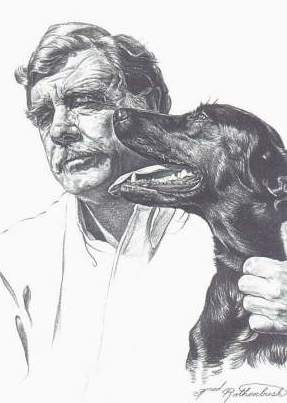
“Hill Country is neither here nor there. It’s the place just over the next rise, that soft pool around the next bend of the stream. Or the cover you always planned to hunt but somehow never did.
It’s the hollow that owls call from in the dead of winter; the thicket that a whitetail always disappears into before you’ve gotten quite unwound. It’s the circle where the big trout was rising before the little one took your fly. It’s the cover that’s full of birds but too thick to shoot. Or where your best bird dog chooses to exhibit his worst behavior.
Hill Country is littered with flies in the trees, three empty shells and no feathers, lost dog whistles and forgotten pocketknives. It’s the place where, if you find enough old tobacco in the pocket of your hunting coat to fill your pipe, you don’t have any dry matches, or, just as bad, vice versa.
It’s the place where the best places to cast from are always two inches deeper than your waders can handle, where the sun is always in your eyes on the easy straightaway shots, and whoever you take there fishing or gunning always has his best day while you have one, you’d rather forget, but nobody lets you.
If we want an old dog to come back for an hour or so from wherever old dogs live forever, all we have to do is ask.
We can be 11 again and fishing with untarnished wonder…
Hill Country is the place we’ve never been or the place we always wanted to go back to. It can be a day we never forget or a day we’ve always dreamed would come to pass.
We can walk in the rain, sit in the sun, or huddle around the fire…whatever seems to be just right at the time. And we’ll talk about the secret things that keep us coming back: the woods we hear when the loons cry; the things we feel when the old dog falls asleep with her head laid lovingly across our knee.
All we need in Hill Country is a few good friends to keep us company on our wanderings.”
As I recline back immersed in his memories of “Hill Country” and wrapped in a warm fleece blanket, I sip my tea and glance round my room. Gene Hill takes me away to the wilds of Missouri, Arkansas, Wisconsin, Michigan, New Jersey, and Maryland’s Eastern Shore. No wonder the stories of “Hill Country” relax me. I have apparently liked and found comfort in the stories of ducks, upland game hunting, dogs, and the great outdoors for quite some time. My home reveals this obvious interest in every room.
My bookshelves hold stories from Hemingway, Wetherell, MacQuarrie, Hill, Michener. and others. Three specific books reveal a treasure of some of the greatest outdoor writing of the 20th century. The Best of Field & Stream, A Treasury of Outdoor Life and Autumn Passages: A Ducks Unlimited Treasury of Waterfowling Classics.
My house displays an array of hand-carved and professionally carved decoys, numerous prints, sculptures, and Bradford Exchange collectable plates of hunting dogs, duck hunting and upland game prints, throws, and pillows,
My love for ducks and duck hunting truly surfaced on one of our many trips to the Havre de Grace (MD) Annual Decoy & Wildlife Arts Festival. A framed print we purchased on one of our many trips of lab puppies and decoys titled Slumber Party by Maryland artist, Mary Lou Troutman, beautifies the hallway wall.
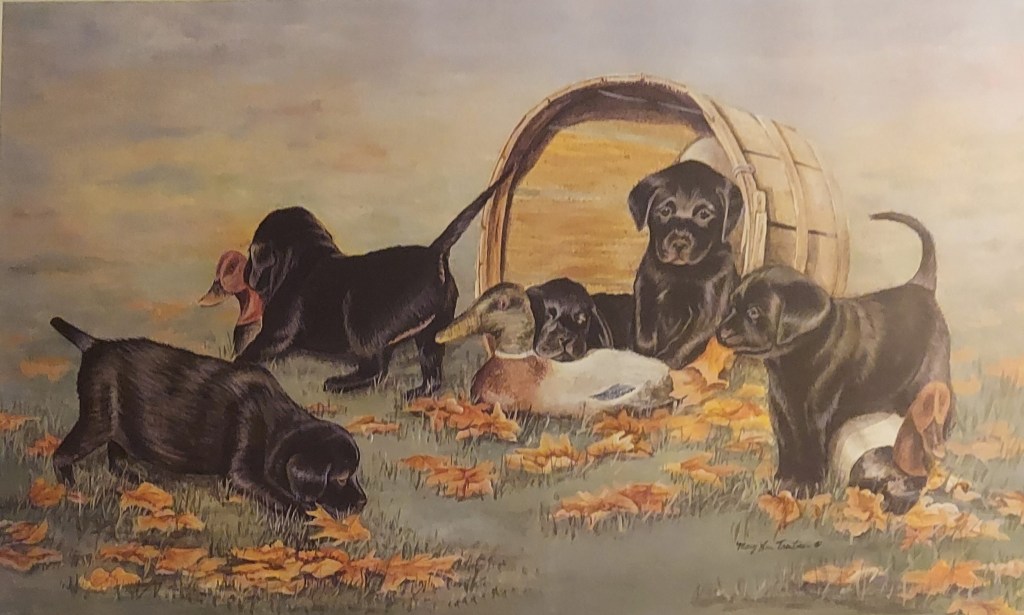
The Havre de Grace Decoy Museum is another one of our favorite stops. The exhibit showcases the rich history of duck hunting from the early 1800s to the present day. Life size animatronics brings the world of the decoy carver to life. Though very interesting, it also highlights the near extinction of a variety of species because of the use of skiff boats and punt guns that were pre-conservation laws and societies like Ducks Unlimited.
Our trips to Havre de Grace and Northeast, MD inspired me, when I was sick and recovering, to read The Watermen by James Michener. The Watermen was one chapter from Chesapeake, but it was also a stand-alone book. (I finally read all 865 pages of Michener’s, Chesapeake, a few years ago, and it did not let me down.)
After looking over my interior decorations, my choice in books, and knowing what relaxes me when I am stressed, I have realized that in my previous life; I must have been a retriever. This would explain the excitement that stops me in my tracks when I see geese flying in their V-shape formation against the greying clouds of fall. It signals cooler weather and shorter days. It is why I get sidetracked when I see them landing in the fields by the hundreds and why I get a sudden burst of energy every time I approach a large body of water. If there are ducks on the water, I have to get a closer look, like a lab, and be there with them in the moment. My husband says I wiggle with excitement.
I find cattails and marshy areas beautiful, serene, and yet a bit mysterious while others say it makes them feel uneasy and cold; not knowing what is there. I can understand the eagerness of the labs as they sense the changing of the seasons. I also have an eagerness as I look forward to the seasons transformations.
Like a working retriever, I look forward to the warmth of the fireplace as it quickly replaces the dampness and cold of late fall and winter and makes my achy joints less painful. The crackling sound of the logs is relaxing music to my ears. Combine this with sitting in a comfortable chair with a fleece blanket wrapped around me while paging through an enjoyable book is sheer tranquility. I have seen that same peace with wet, tired labs after a hunt, as they curl up on a cushy bed or rug in front of a fireplace; steam coming up from their exhausted body, their legs start moving, small sounds are emitted from their mouth, deep breaths and sighs are made and from time to time, their tail wags.
A sip of brandy, scotch, or tea is always welcome as I relax. Though I do not smoke, I would not mind someone sitting next to me smoking a pipe of Captain Black tobacco and reading a good book alongside me. The aroma takes me back to my childhood when my father was more easy-going and enjoyed time with his family.
I relish in the yarns of the many talented writers that I travel with early in the morning because they talk of a simpler time; one they cherished with family, friends, and magnificent dogs. Along the many roads I have traveled, I experienced the joy and sadness of a world that is foreign to me, yet somehow, their stories also draw me in as if I am there.
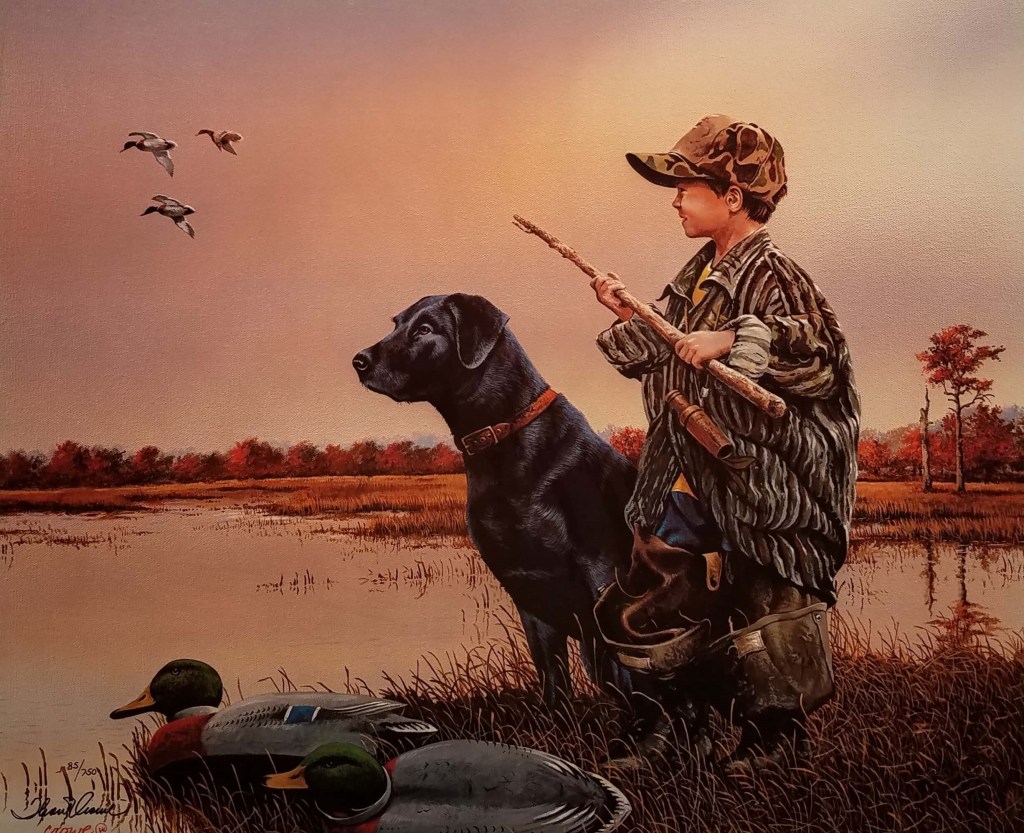
Many young boys no longer follow in their father’s footsteps of duck hunting as cell phones and social media sites have captured their full attention. Some parents possess dogs as mere objects to entertain children, while some treat the dog as family. As for dogs being exposed to the world of duck hunting and retrieving, well I am afraid that is on its way out for sport.
Though some landowners allow select hunters to use their grounds and some states set aside game lands, the hidden get-aways that hunters searched for have nearly disappeared. Today, many hidden duck hunting locations are off limits; replaced by professional plantations with guided shoots. These professional venues have no personal touches or pictorial memories that tell the stories handed down from generation to generation. The pictures that hung at the camp are now fading away. Jackets, boots, and decoy bags that held cherished memories deteriorate like life itself.
Duck calls and abandoned boats are found hidden buried among the vegetation; shotguns are sold despite the monetary value they still hold. Today’s generation is persuaded by politicians and activist groups that all guns are bad. The people using guns during the early days did so, not only for sport, but to supply commercial markets with food and the fashion industry with feathers. Some lived off the land and for them, guns and duck hunting were a way to survive.
Today, shooters often rent dogs which are professionally trained rather than training a new pup to bond with them. There is no replacing the memories made between a hunter and their own dog. If they are lucky enough to find a special location, raise and train their own pup, the memories they create will never fade.
I absolutely love reading about the comical side of duck hunting like Hill wrote, but not all stories were happy or funny. Reading of old men excited to set out one last time donning their patch-worked hunting coat, torn waders, and frayed hat only to realize they could no longer see them approaching across the autumn sky or hear the beating of the wings as they descended for the splashdown was a reminder that we all grow old. Live life when we are young, so the memories can follow us as we age.
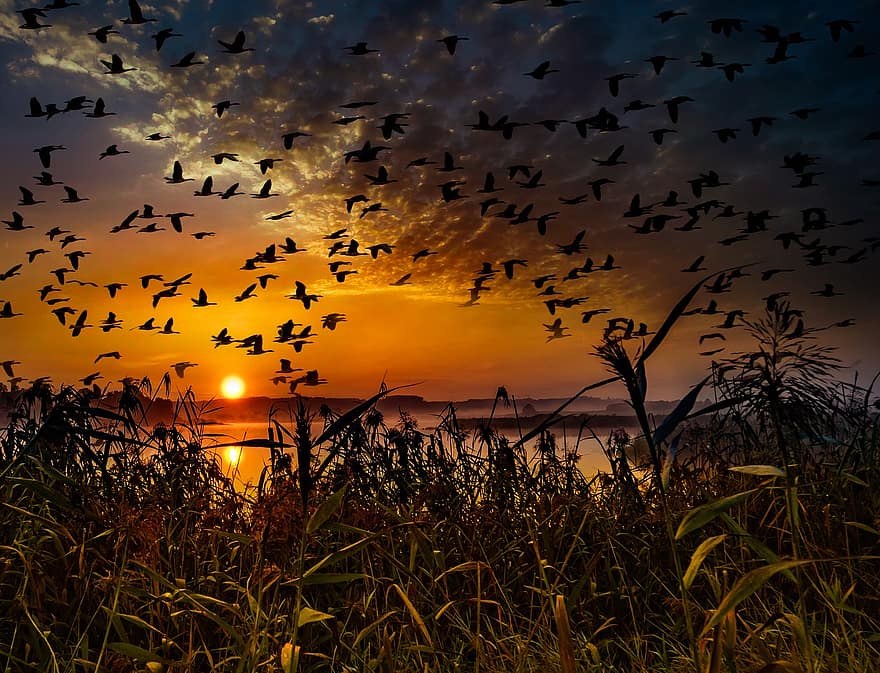
I will always be excited to see V-formations of geese or ducks flying into a pond or marsh. I will always enjoy decoy museums and duck calling competitions; watching the dogs work the water with simple whistle and hand commands of their handler. I will always enjoy my home’s décor, sitting in front of the fireplace and staying warm with my fleece blankets and a beverage. But most of all, I will always enjoy the time spent with my friends between 1 and 2 am, traveling the country and sometime the British Isles.
It is a different type of life, but one I relish. Could I ever be a duck hunter? Hell no. Could I ever raise a pup of my own and teach him to fetch like a champion retriever? Probably not, but I can teach him or her to splash in the water, enjoy the outdoors, especially fall and winter, to take a hike with me and to relax by a fire after an exhausting day. I can enjoy the stories and pictures that have been passed down from generation to generation. Generational stories are story telling at its best, especially when it lets me get whisked away in my imagination to relax in new places and enjoy fresh adventures. Insomnia for me has given me has not been all bad.

 Wingman Copywriting
Now that you mention it, you probably WERE a retriever in a previous life. It all makes sense now! lol. We’ve been to the decoy museum in Havre-de-Grace a few times. I love that little town, and the boardwalk along the Chesapeake!
LikeLike